“Just another low-cost press? That would completely miss reality.”
It was supposed to be a simple, scaled-down press for the entry-level segment. Looking back at the development of the ALPHAFLEX, Head of Development Dr. Björn Feldhaus smiles.

Dr. Björn Feldhaus
“We realized that this idea made no sense. It simply doesn’t fit the reality of modern flexographic printing. So we started all over again and asked ourselves: what kind of machine really makes sense today? What do you need in production – as a newcomer, as someone switching technologies, in a small business or a large operation?”
In this interview, Dr. Björn Feldhaus talks about misconceptions in machine design, intuitive operation and why the ALPHAFLEX even managed to surprise its own engineers.

At K 2025, W&H demonstrated that the new ALPHAFLEX can achieve a continuous printing speed of not only 400, but 500 m/minute – even with complex designs.
With the ALPHAFLEX, W&H is offering a flexographic press aimed at the entry-level segment for the first time. Isn’t there already plenty of competition? Can W&H really compete on price?
Dr. Björn Feldhaus: To be honest, that’s exactly what we asked ourselves during development. The first design concepts focused on reduction – less complexity, fewer features, maximum accessibility. We thought the goal was clear: a lean press line, attractive price point, eight colors.
But the result didn’t feel credible. Because anyone investing in new equipment today expects more than just “enough.”
So we went back to the drawing board – technically, structurally, in terms of controls and ergonomics. The result is a press that deliberately breaks with traditional entry-level thinking. In the end, we built a system that still surprises us today, in a good way. In some areas, we even exceeded our own expectations, especially in real print performance.
So the ALPHAFLEX is not a stripped-down W&H press?
Feldhaus: The ALPHAFLEX is not a reduced machine. It is a fully capable press with all the features that matter today. It’s not designed to be cheap – it’s designed to set new standards in its class. Yes, in web width, number of colors and price it sits in the entry segment, but what you get for that changes the definition of the entire class.
We made a conscious decision to allow ourselves a little more freedom in pricing, which enabled an outstanding balance between price and performance. [laughs] In many details, we developed so far beyond expectations that we surprised ourselves.
“Customers came with their most difficult designs – and were speechless.”
You said you surprised yourselves. How so?
Feldhaus: For example, in the way we designed and integrated the inking unit into the print deck. That resulted in exceptionally smooth running and precise axis control – far beyond anything previously seen in this class. We achieved the lowest bounce rate in the entire printing industry.
For our customers, that means they can print even the most demanding designs at full speed – 500 meters per minute. We’ve demonstrated this live at K 2025, because that number isn’t theoretical. It’s proven.
We invited printers from several countries to our Technology Center and asked them to bring their toughest jobs. They were speechless. Jobs that usually run at 200 or maybe 300 m/min in their production ran effortlessly at 500 m/min on the ALPHAFLEX, with hardly any adjustment. One customer turned around and said, “My god, it’s a beast!”
And while delivering that performance, the press still saves up to 25% in drying energy consumption.

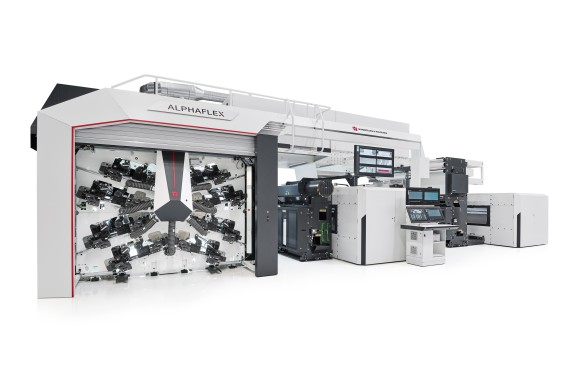
CI flexo printing deck of the ALPHAFLEX
It sounds like the ALPHAFLEX is defining a new class. How do you develop something like that?
Feldhaus: Curiosity and humility help a lot. A good press is not born at a desk or on a screen. It comes from observation – visiting customers, being on the shop floor, talking with operators and production managers.
That is exactly how we developed the ALPHAFLEX: together with small and mid-sized printers as well as international players. Reliability and efficiency are just as essential for global converters as for a family-run business.
Performance is not only about bounce rate or a single technical feature. It’s about the entire process: job changes, varying operator skills and increasingly complex print demands. That’s why our main goal was simple – everything had to become easier.
Shorter setup times. More efficient use of resources and energy. The in between color dryers that switch off automatically when not needed, reducing operating costs without affecting production. The result: up to 25% lower energy costs. And, true to our German engineering roots, we made sure that was verified and certified immediately.
What kind of company is the ALPHAFLEX designed for?
Feldhaus: Today, technology must be thought of independently of company size. The same goes for usability and flexibility. “Easy to use” doesn’t mean simplified by omission – it means smart reduction through careful observation.
What really matters at half past three in the afternoon during a job change? You can’t compromise – not in a small shop, not in a corporation. Not on quality, not on service, not on support. This business doesn’t allow it. Cutting corners costs production time, volume or operator satisfaction – and then you lose your operators. Everyone in the industry knows that.
The ALPHAFLEX is our answer. It adapts to different organizational structures. It’s designed for companies that want to expand their production without rebuilding their entire operation. There are no compromises in quality, performance, or ease of use.
It even assists operators during job changeovers and warns against small but critical mistakes. Ask the night-shift operator – he’ll tell you. And his supervisor’s too: “Finally.”
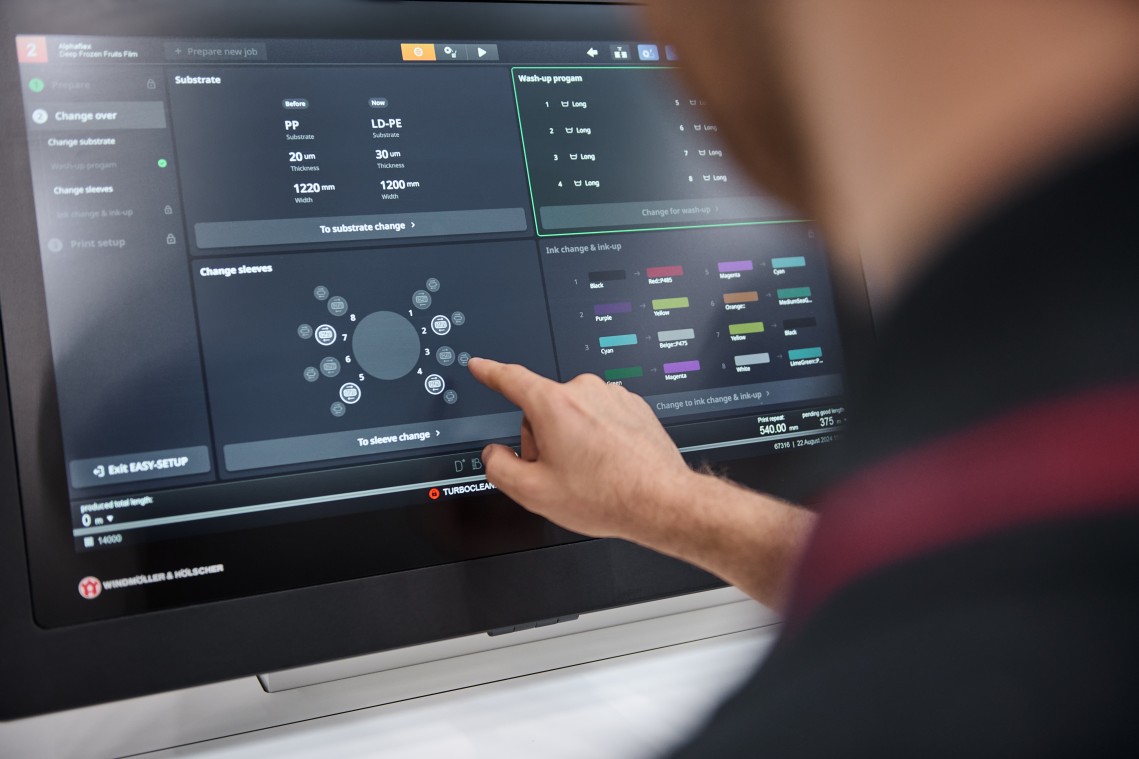
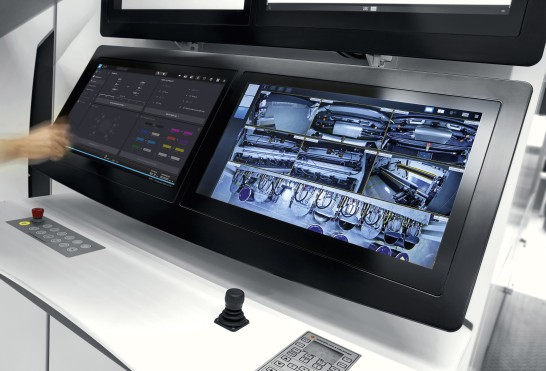
EASY Setup and other software components drastically simplify job changes and set-up procedures – even for less experienced operators.
Flexographic printing involves complex adjustments and growing demands. How do you make that easier?
Feldhaus: Many printers face the challenge of finding and retaining experienced staff. The ALPHAFLEX was developed precisely for this reality. Its operating concept is clearly structured; and assistance systems such as EASY Setup provide targeted support without adding complexity.
Even less experienced operators achieve consistent results quickly, while experienced teams benefit from reproducible processes and high repeat accuracy. Printing becomes more predictable, more stable and more efficient.
As I said, curiosity and real-word feedback from the production floor help immensely. Our job is to design for those realities – not just to add one more feature.
Is the ALPHAFLEX really an entry-level press?
Feldhaus: I don’t think those categories fit anymore. We wanted to make CI flexographic printing more accessible without lowering standards.
The ALPHAFLEX is powerful, intuitive and fits naturally into different production environments. Not because we wanted to offer less, but because good technology performs best when it’s easily accessible.
We developed it for a segment where ease of operation and cost efficiency matter most. And that is exactly where the ALPHAFLEX sets new benchmarks – a combination of productivity, stability and user-friendliness that simply didn’t exist before.
Whether as an entry solution with room to grow or as an addition to existing production lines, the ALPHAFLEX is ideal for first-time CI flexo users, smaller printers demanding more from this class, and large converters seeking to scale or diversify production flexibility.
What comes after the ALPHAFLEX?
Feldhaus: [smiles] Let’s just say this: ALPHA was only the beginning, quite literally. We plan to redefine how much productivity you can expect in each class and how easy it can be. Stay tuned for 2026. It’ll be worth it.