The Art of High Quality Winding
In film processing, the winder is often perceived as the last station on a line. The film is extruded, coated or printed, the material web runs stably, and a roll is created at the end.
From a technical point of view, however, this view falls short. This is because the winding process is a key factor in determining whether the material produced can be reliably processed in downstream processes. However, a roll is not just a transport or storage format. It is an intermediate product, the quality of which influences the performance of the entire value chain - from extrusion to printing, lamination and coating to further processing on application-specific processing machines.
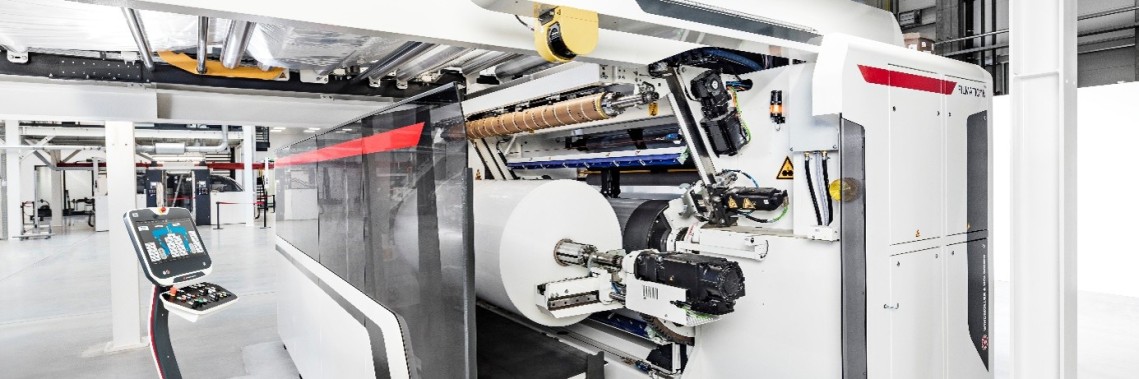
FILMATIC II N mono winder
And this is precisely why winding is not regarded as a peripheral function at W&H, but as an independent process engineering discipline.
The Roll determines the Success of the Downstream Processes
A high-quality roll is much more than material that has been neatly wound. Material web tension, pressure, roll hardness, cutting quality and edge guidance determine whether a roll can later be processed at high speed and with reproducible quality. Even small deviations can lead to downstream systems running more slowly, additional control measures being required or rejects occurring.
Typical quality problems often do not become apparent in the original production process, but only in further processing. Flatness defects due to post-crystallization, local overstretching of the material web, so-called tin-canning effects or insufficient edge straightness often only become apparent when the roll is already being processed on another machine.
The causes of such errors often do not lie solely in the actual winding process. In film extrusion, for example, upstream process steps such as edge trimming, pre-treatment or spreading influence how a material web can be rewound later. The winder thus becomes the hub of various process steps, where the effects of many previous parameters and influences are concentrated. A process-technically optimal winding solution therefore considers the entire material guide both before and after the roll to be wound.
Winding means mastering materials physics
At first glance, winding seems to be a simple process: a material web is wound onto a winding core. In fact, however, numerous physical influencing variables overlap. Material web tension, winding speed, contact forces, material elasticity, surface properties and roll geometry influence each other.
A roll that is wound too softly can become unstable. A roll that is wound too tightly can build up internal tensions, which can later lead to flatness problems or, in the worst case, to telescoping (displacement of material layers on the roll), which turns the entire roll into a scrap. The optimal setting always depends on the material and the subsequent application. This is precisely why there is no universal winding strategy for all products.
Modern special films are particularly sophisticated. MDO-stretched materials, highly sticky stretch films, pressure-sensitive surface protection films or multi-layer decorative films (interior and exterior films made of PVC, PMMA or PET composite) each place completely different demands on the roll structure.
This can be illustrated by the example of surface protection films for the electronics industry. The films that are produced there are later applied to displays or electronic components. Even the smallest creases, pressure marks or local material defects can lead to high-quality end products no longer meeting the quality requirements. In such applications, it is not enough to produce the film with high quality. The roll structure must also fully preserve the product properties.
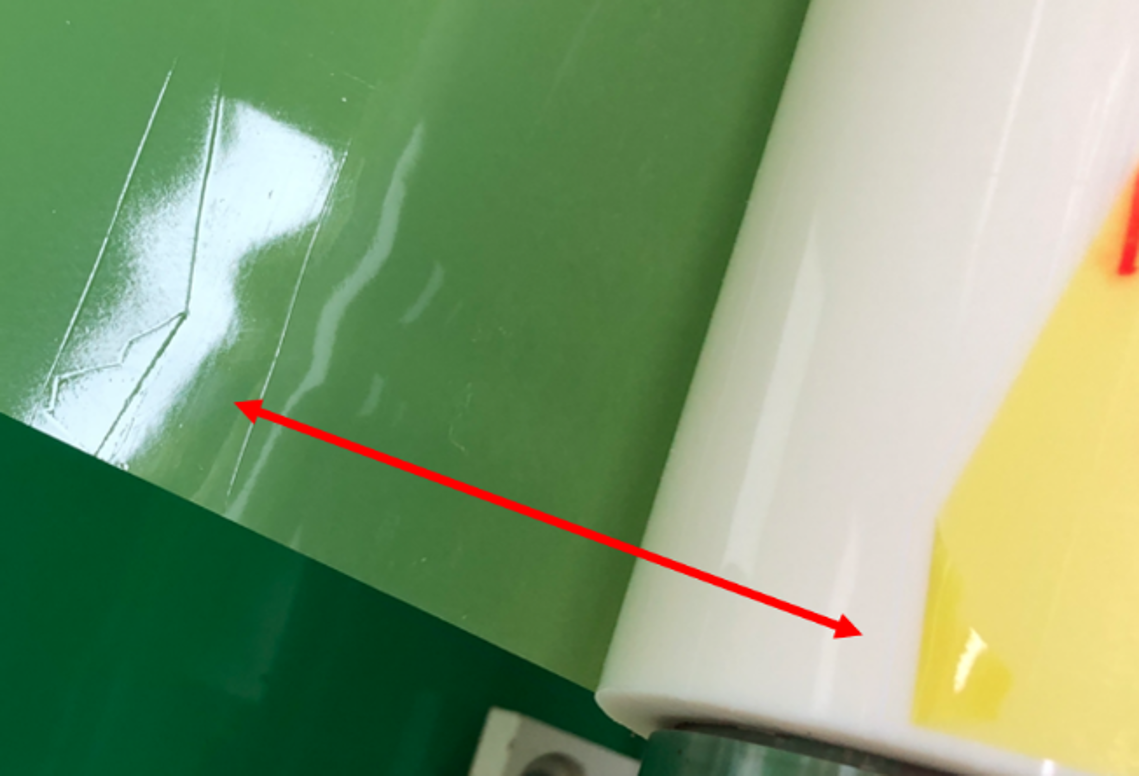
Example of a roll problem due to incorrect winding start: visible after 100 m
The Roll Start Influences the Entire Roll
A critical but often underestimated factor is the roll start. Even the first windings at the winding core influence the quality of the entire roll.
If the material web turns over during winding and wrinkles or local material accumulations occur, these can push through over numerous film layers. What begins in the winding core area can later be visible far away from the roll center.
An example from the surface protection industry shows how strong this effect can be. There, particularly pressure-sensitive protective film as thin as 25 μm is processed. A folded film edge at the beginning of the roll can still be seen after hundreds of meters of winding length in the roll. Although the actual film is produced flawlessly, the high product quality decreases again due to a poor roll structure.
Why winding technology starts with product development
In many development projects, the initial focus is on producing a film with defined product properties. The question of how well this material can be wound later, on the other hand, is often only considered later. However, this is precisely where there is considerable potential for optimization.
Experience shows that early involvement of winding expertise helps to create the prerequisites for stable further processing as early as the product development stage. For this reason, we often test sample rolls with converters during the development phase. This not only evaluates whether the film has the desired material properties, but also whether it can be reproducibly processed as a roll.
Customers interested in winders will also take advantage of the opportunity to test the winding and cutting behaviour as well as the roll change of their own rolls in the W&H technology center and to receive comprehensive advice. This is then done independently of extrusion or converting trials if W&H winders are to be integrated into existing third-party systems at a later date.
From a simple winder to a process engineering solution
Not every material has the same requirements. Thin stretch films, technical special films or thick material webs require different winding concepts. That's why a successful solution doesn't start with the parameters, but with the choice of the right winding principle and the right machine configuration.
Depending on the application, different drives, web tension zones, contact force systems or special roller surfaces may be required. Some products require a particularly soft roll structure, while others require specifically high contact forces for a stable winding. In addition, factors such as shaft deflection, roll mass, contact force distribution and web tension play a decisive role. The wider the web and the larger the roll becomes, the greater the effects on the winding result.
Where does W&H's winding expertise come from?
W&H has experience from more than 4,000 installed winding stations worldwide. The spectrum of applications ranges from thin stretch films under 10 μm to technical films with material thicknesses of over one millimeter.
The experience is not only created by installed machines. W&H regularly accompanies product qualifications, supports customers in developing demanding applications and contributes process engineering knowledge directly to development and optimization projects. This is often not just about putting machines into operation, but also about optimizing products specifically to meet specific quality requirements.
Winding expertise far beyond flexible packaging
The fundamentals of winding are the same whether it is packaging film, hygiene film or a technical material web. Accordingly, W&H winder technology is now used in a wide range of applications that go beyond flexible packaging. These include agricultural and stretch films, surface protection films for the electronics industry, decorative films for interior and exterior applications or materials from coating and painting processes.
In some cases, the requirements differ considerably. While packaging films are often in the range of 20 to 120 μm, decorative films for floors, facades or architectural applications can reach material thicknesses of over one millimetre. In addition, there are structured surfaces, different composite materials and different quality requirements. It is precisely this diversity that characterises the further development of winding technology at W&H, which can also be used independently of extrusion or printing machines.
Technology highlights from practice
The real strength of W&H’s winding technology lies in its ability to tailor different winding principles to specific applications. The question of which winding concept best supports the physical requirements of a material is decisive.
A good example of this is the start of the roll. As already described, even the smallest defects in the winding core area can affect the quality of the entire roll. In order to achieve the most defined roll start possible, W&H uses the vacuum contact cutter drum (VSK) for certain applications. In contrast to conventional solutions, the material web is separated directly on the roll at right angles with a knife that cuts out of the contact roller and transferred to a new winding core in a controlled manner. This creates particularly uniform starting conditions during roll construction, which significantly reduces the risk of fold-overs or winding winding core defects.
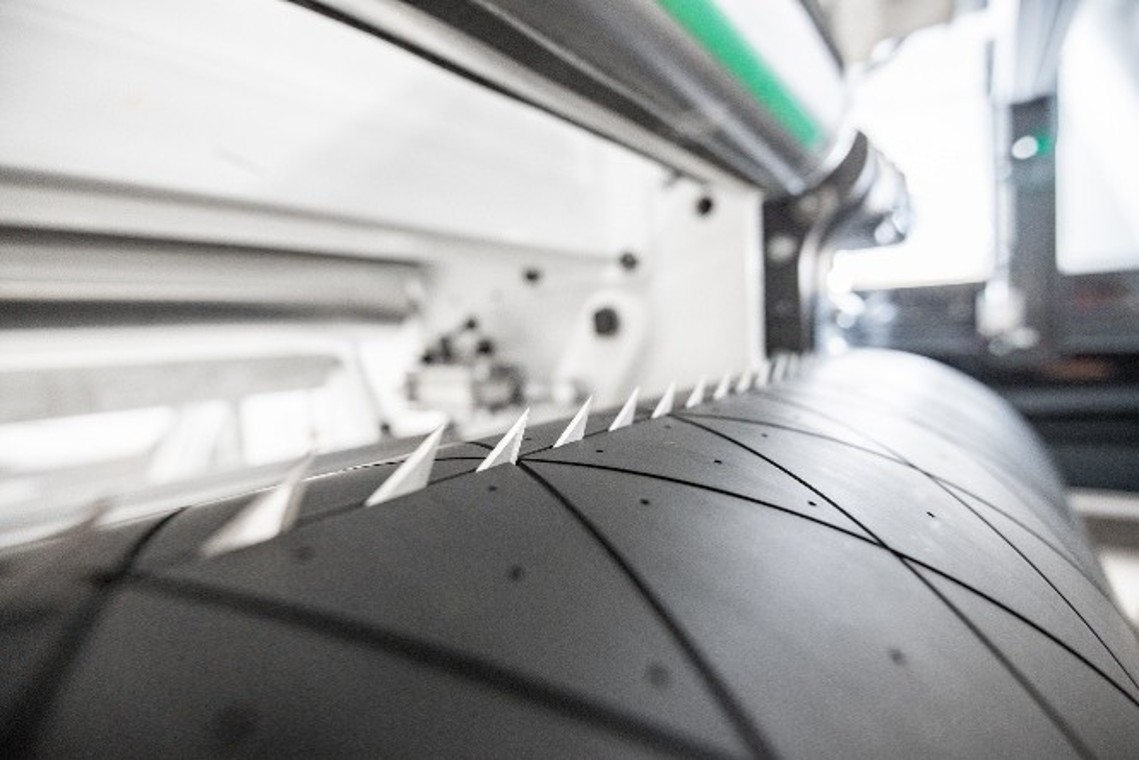
Vacuum contact cutter drum with knives cutting from the inside of the drum
The requirements for contact forces during the winding process are just as varied as the materials. The FILMATIC II N winder uses gravity for particularly uniform contact force forces over a large web width. Swivelling support rails allow the weight force of the roll to be used in a targeted manner to build up high and evenly distributed contact forces without unevenly bending the winding shaft. This allows contact forces of up to 2,500 N to be generated even with small winding shafts. This concept offers advantages for roll quality, especially with sticky materials. For sensitive film, the additional lay-on roller can be used to enable the smallest contact forces when processing pressure-sensitive film.
A further challenge arises with increasing web width and roll size. The larger a roll becomes, the greater the influence of winding shaft deflection on the distribution of contact forces across the web width. For wide mother rolls with large diameters, this can have a direct impact on winding uniformity. For such applications, W&H relies on the FILMATIC TC concept, among other things. A special double bearing reduces the deflection of the winding shaft, so that uniform pressure is achieved even with working widths of up to 4.3 metres. This helps to meet high quality requirements with large roll weights and high production speeds.
These two examples from the winding portfolio illustrate how closely mechanical engineering and process engineering are linked at W&H. The focus is always on the question of how specific physical challenges can be mastered with the right technology in the winding process. This combination of application expertise, material know-how and machine development is what defines W&H winding technology.

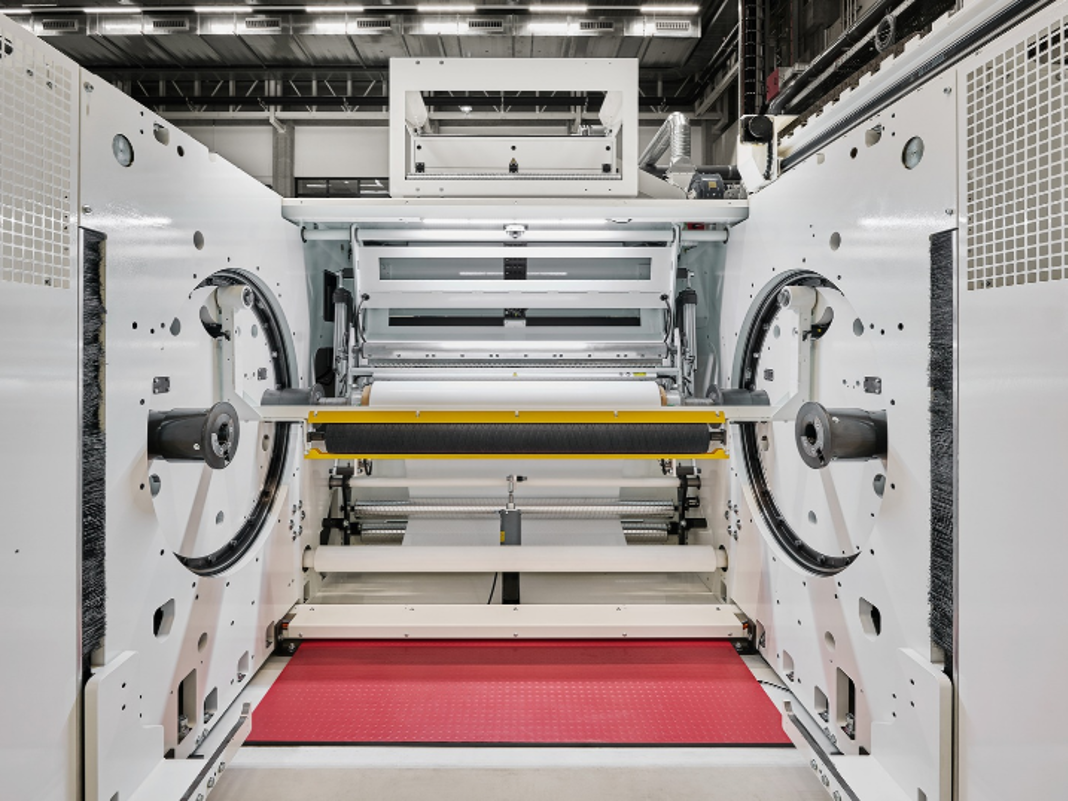
FILMATIC II V dual winder
Long-term guaranteed machine availability
For W&H, winding technology does not end with the commissioning of a machine. Many winders remain in operation for more than 20 years and have to adapt to new products, changed production requirements and current safety standards (e.g. new Machine Regulations or Cyber Resilience Act) during this time.
Thanks to the modular machine design of many winders, safety functions, automation solutions or individual technology packages can be retrofitted in a targeted manner. With these retrofit solutions, W&H supports customers in keeping existing systems technically up-to-date in order to ensure long-term operational capability.
This is supported by a worldwide 24/7 service and support network that accompanies customers throughout the entire service life of their plants. As a result, operators benefit not only from long-term technical support, but also from continuous process engineering know-how for new products and applications.
Do you have questions about winding products?
Please feel free to contact us, we will be happy to advise you or support your trials at our Technology Center
Fabian Sundermann
Director R&D Winding Technology